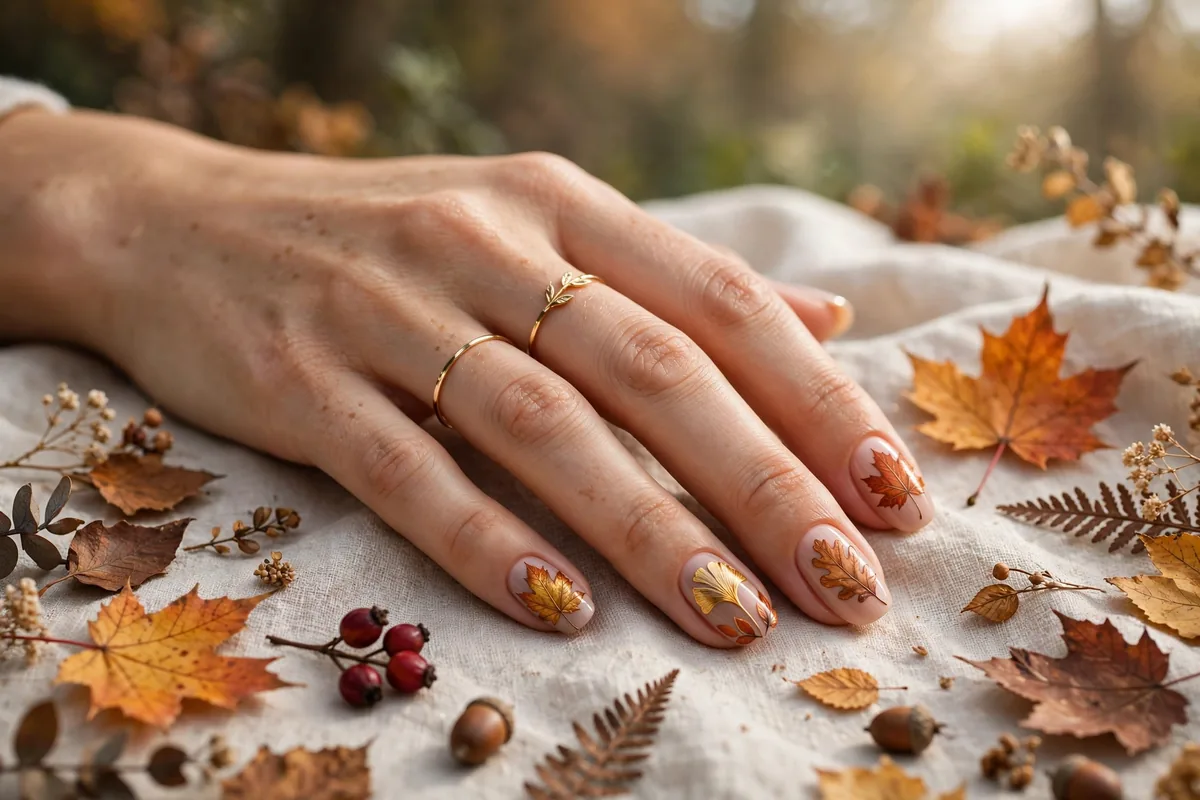
Autumn leaves are fall’s most beautiful motif — and they translate to nail art spectacularly.
The leaf-art palette: burnt orange, golden yellow, deep red, and chocolate brown — real foliage colors on a tiny canvas.
From single accent leaves to full falling-leaf scenes, these 20 designs capture autumn.
Here’s your foliage collection. Let’s get into it.
Single Maple Leaf
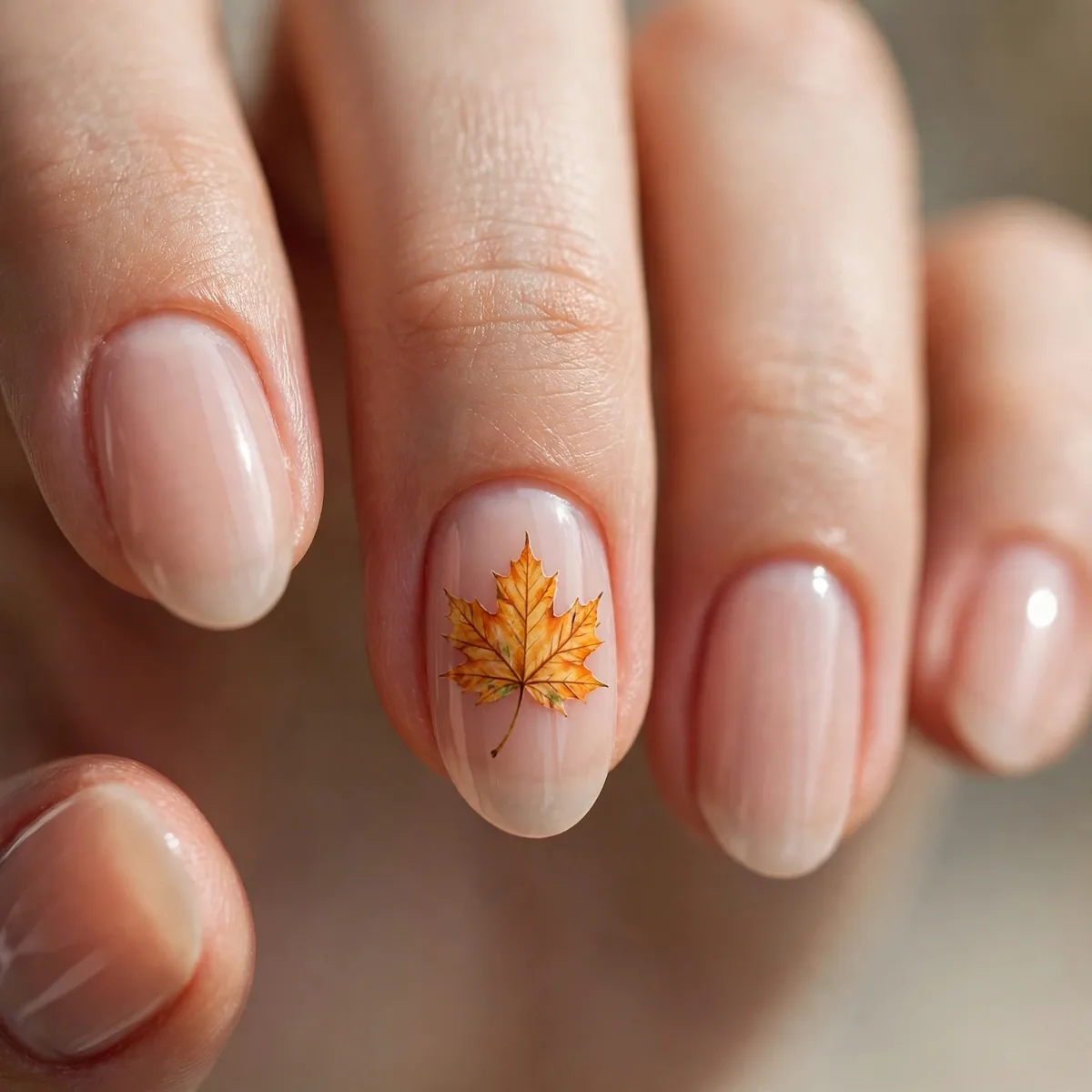
One detailed maple leaf on a nude base — the iconic fall.
Best for: the classic. The maple leaf IS autumn.
A maple leaf demands detail, so paint it over two thin coats of nude and let the base cure completely — dragging wet nude ruins the canvas. Use a liner brush for the pointed lobes and a dotting tool for the stem; five to seven points read as maple, fewer look like generic leaves. Burnt orange or oxblood paint gives the most authentic fall read. Keep the leaf centered slightly toward the cuticle for visual balance.
This is the signature fall manicure — iconic enough to carry the whole season on one nail. Place the leaf on your ring finger and keep the other nine nails in a simple nude or sheer so the artwork gets its spotlight. Beginners should try leaf decals first; hand-painting maple lobes takes real practice. Seal with a glossy top coat to make the leaf look lacquered and deliberate.
Falling Leaves Scene
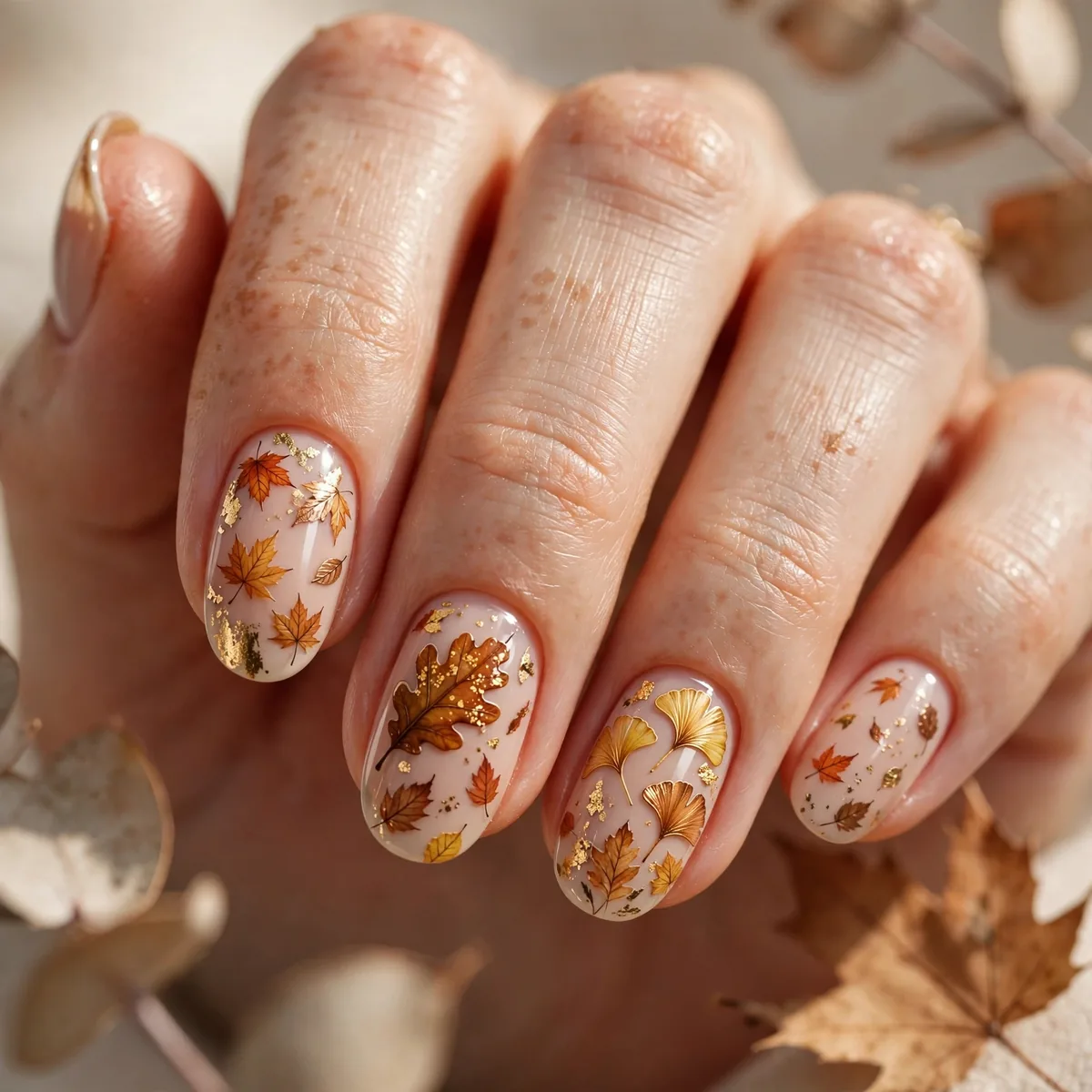
Multiple leaves mid-fall across nails — the autumn moment.
Best for: the storytelling. A whole season on ten nails.
A scene manicure works when leaves vary in size and angle — identical leaves look stamped, while scattered sizes feel windblown and natural. Paint larger leaves near the cuticle and smaller ones drifting toward the tip to create depth. Mix two or three fall shades so the composition has dimension. Work across all ten nails as one canvas rather than repeating the same design, letting the scene flow.
Longer nails give a falling-leaves scene the room it deserves — almond or coffin shapes become little canvases. This is a weekend project, not a weeknight one; expect a full hour for both hands. If freehand leaves intimidate you, scatter tiny leaf stickers over a gradient base and the storytelling still lands. Photograph this set in golden-hour light; the warm tones practically glow against autumn backgrounds.
Burnt Orange Leaves
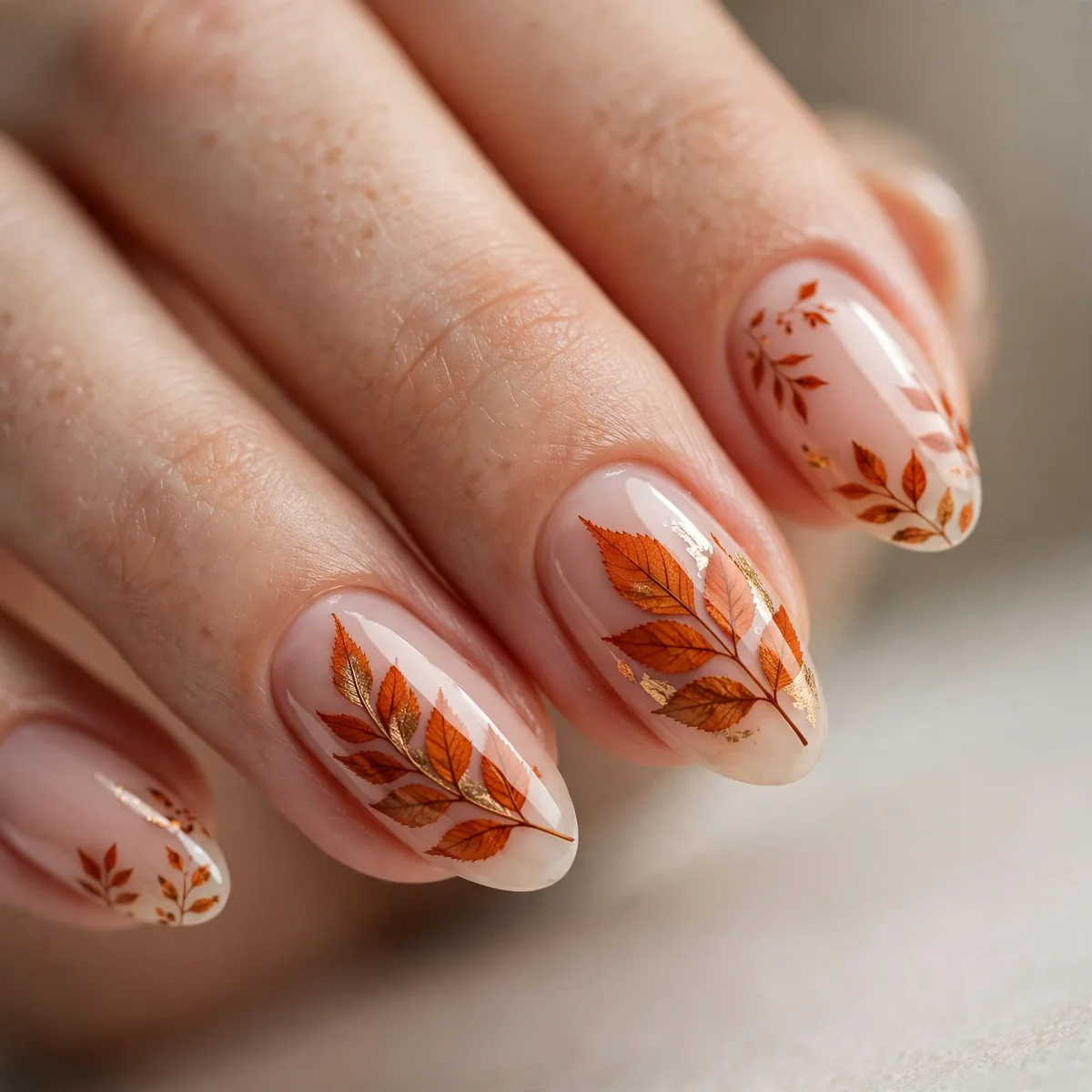
Leaves in burnt orange — the quintessential fall.
Best for: the traditional. Burnt orange leaves never miss.
Burnt orange is fall’s anchor shade — look for polishes with brown undertones rather than neon brightness, which reads summer instead of autumn. Crème finishes show the depth best, though a subtle shimmer mimics sunlight on foliage. Two coats over a neutral base usually reach full opacity. This shade flatters warm and olive skin tones beautifully; cooler skin should pair it with gold accents to bridge the warmth.
Burnt orange leaves pair naturally with cozy textures — think chunky knits, suede boots, and pumpkin-spice everything. The color wears well for seven to ten days, hiding tip wear better than darker shades. For a modern twist, alternate burnt orange leaves with solid chocolate nails; the contrast feels rich and intentional. Touch up with cuticle oil daily, since dry cuticles dull warm shades fastest.
Golden Leaf Foil
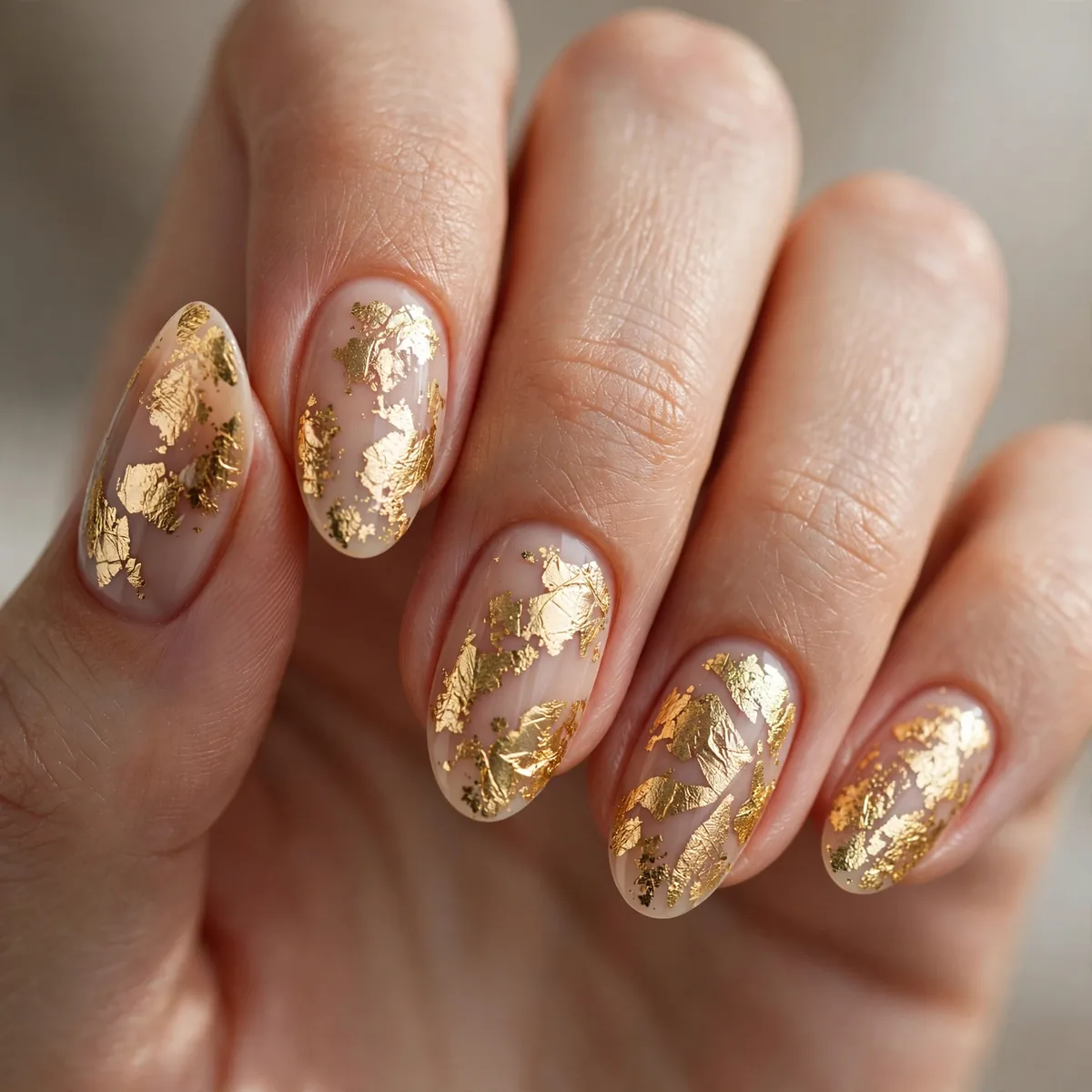
Real gold foil as leaves — luxe foliage.
Best for: the glamorous. Gold leaves are autumn jewelry.
Gold foil adheres best over a tacky layer — apply foil glue or press foil into polish that is dry to the touch but not fully cured. Tear pieces small and press with a silicone tool, leaving edges slightly lifted for a dimensional, organic look. Burnish gently; aggressive rubbing flattens the texture that makes foil beautiful. Seal with two coats of top coat, capping the free edge, or foil lifts within days.
Foil is the jewelry of nail art — it catches candlelight and evening sun in a way paint never can. Because real foil varies piece to piece, no two nails match, which reads as luxury rather than inconsistency. The tradeoff is texture: foil feels slightly raised, so a thick gel-effect top coat smooths it for daily wear. Save this design for events and the holiday stretch, when the extra glam earns its keep.
Burgundy Foliage
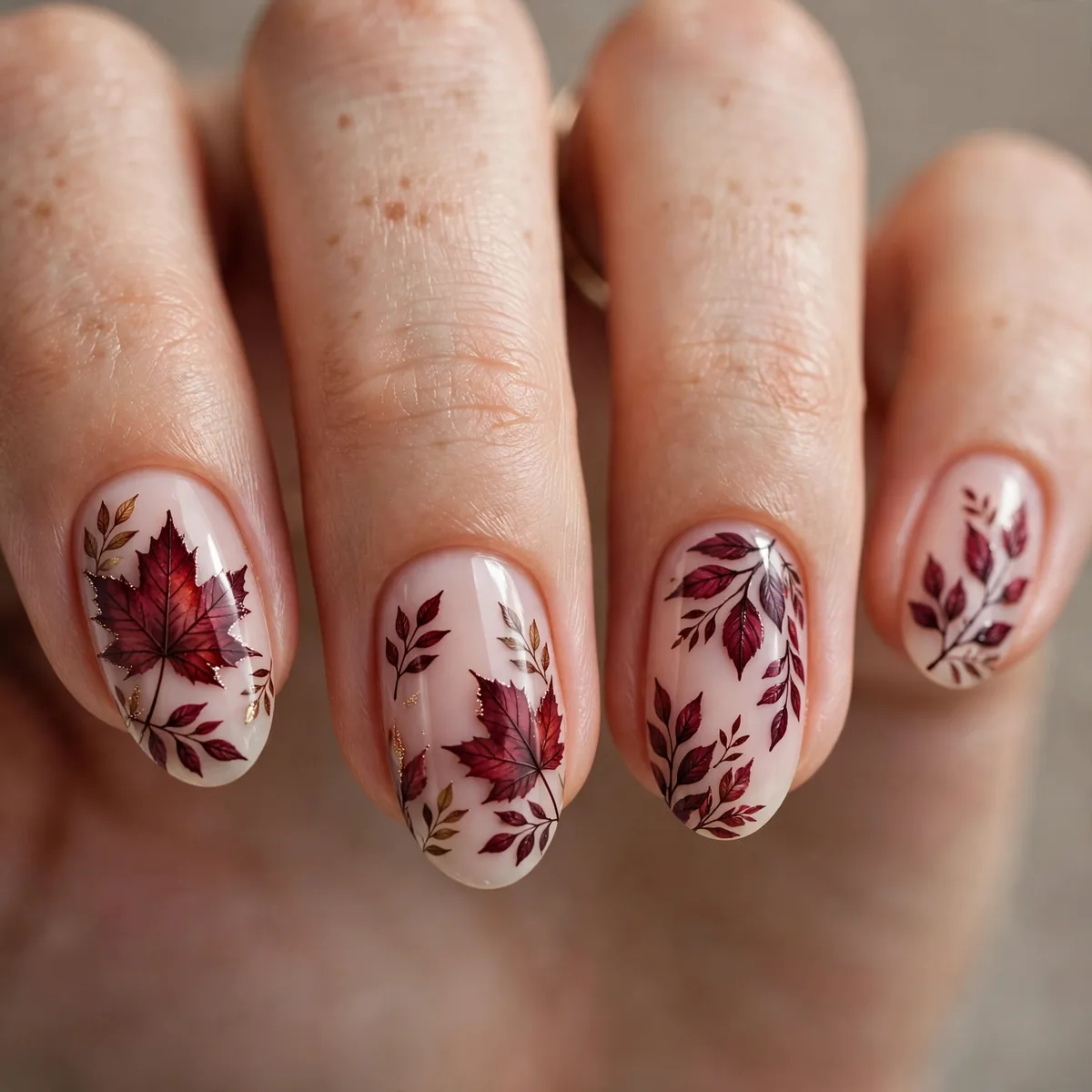
Deep red leaves — the moody fall.
Best for: the dramatic. Burgundy foliage is rich and deep.
Burgundy is a vampy, wine-dark shade — it reads nearly black indoors and glows oxblood in sunlight, which makes leaf details pop dramatically. Apply over a dark base rather than white for the richest depth; leaves painted in copper or gold metallic stand out best. This shade stains, so double base coat is wise. Medium to long almond nails give burgundy its most dramatic stage.
Burgundy foliage is the moody autumn manicure — it pairs with leather jackets, dark denim, and red wine nights. Because the base is so dark, regrowth and chips show less, stretching wear to a comfortable ten days. Add a matte top coat for a velvet effect that feels incredibly luxe, or keep it glossy for classic shine. This design transitions seamlessly from October straight through the holiday party season.
Nude Leaf Silhouette
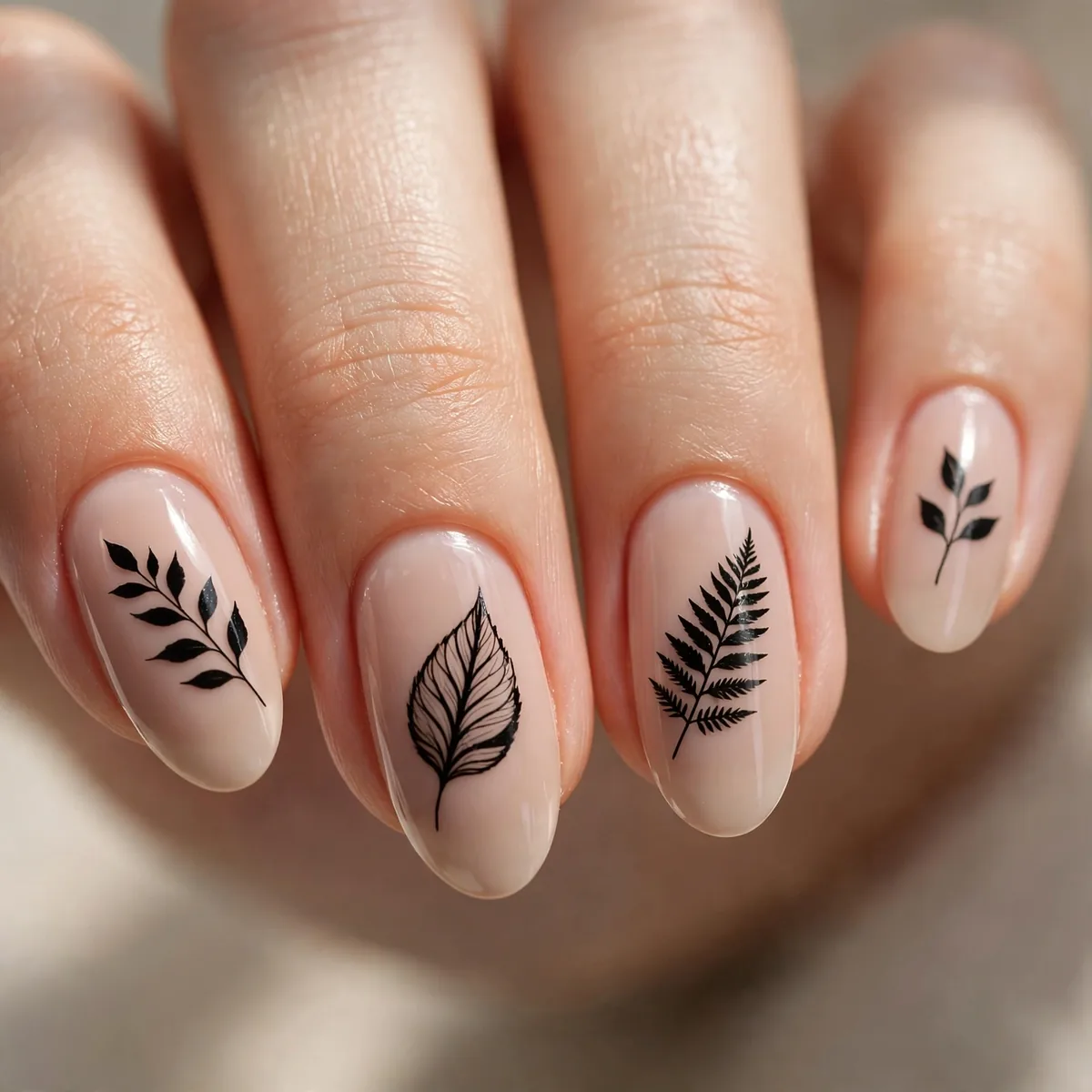
Dark leaf silhouettes on nude — the minimalist fall.
Best for: the understated. Silhouettes suggest without shouting.
Silhouettes need contrast to read — choose a leaf color at least three shades darker than your nude base, like espresso or deep forest. Paint the leaf shape solid with a medium brush, then refine edges with a clean liner brush dipped in base color. Keep the silhouette simple; intricate veins get lost at this scale. Short, neat nails suit this minimal design best, where precision reads as polish.
This is quiet luxury for fall — the manicure equivalent of a cashmere sweater. Because the base is nude, grow-out is nearly invisible and the set looks fresh for two full weeks. It works in conservative offices where bolder autumn art might raise eyebrows. If one leaf feels too plain, add a second smaller silhouette on the thumb for balance. A satin-finish top coat keeps the minimalism soft rather than stark.
Ombre Leaf Gradient
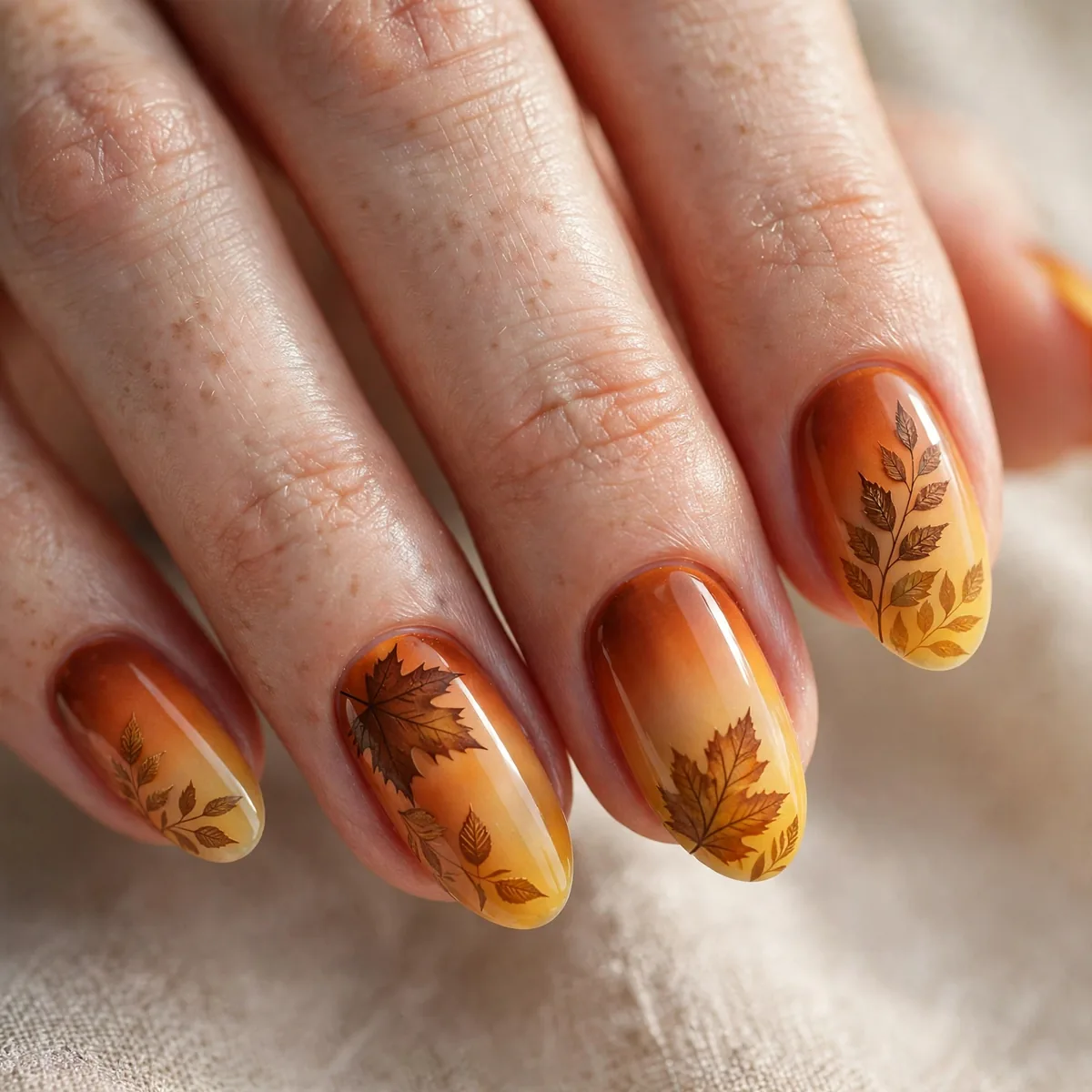
Leaves over an autumn ombre — depth and design.
Best for: the dimensional. Ombre bases make leaves pop.
Layer the design in the right order: build the autumn ombre first, let it dry completely, then paint leaves on top so they sit crisp over the gradient. A vertical ombre — deep plum at the cuticle fading to amber at the tip — gives leaves a sunset backdrop. Sponge the gradient in thin passes to avoid texture. Leaves in a single dark shade read cleanest over a busy base; multicolor leaves fight the gradient.
This combination delivers maximum drama — it is the design people stop you to ask about. Longer nails are almost required; short nails cannot hold both a gradient and leaf detail without crowding. Budget real time here: gradient plus hand-painted leaves runs over an hour for both hands. For a shortcut, use an ombre press-on base and paint only the leaves. Seal generously, since layered art chips in strata.
Tiny Leaf Confetti
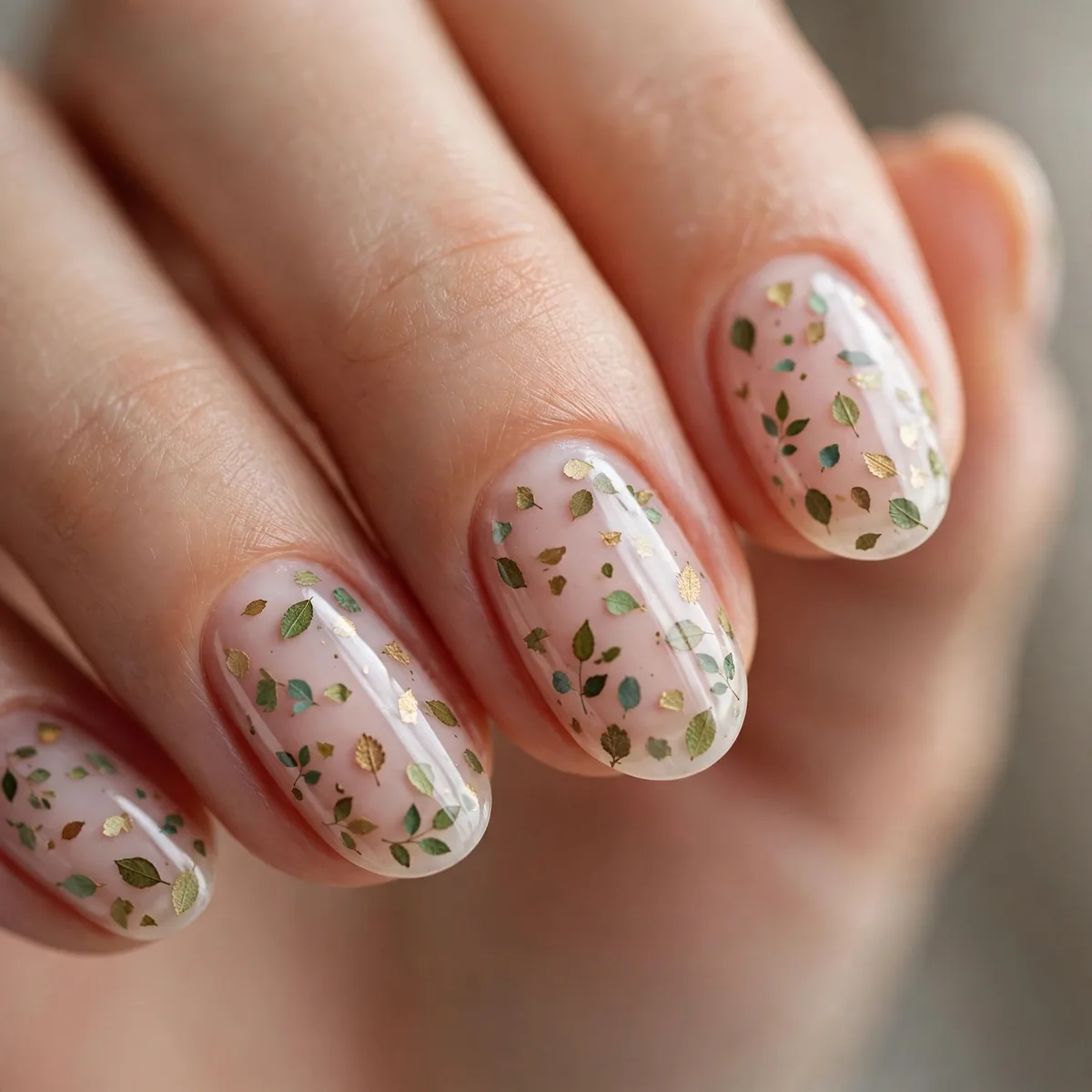
Micro leaves scattered like confetti — playful fall.
Best for: the fun. Tiny leaves are autumn confetti.
Confetti leaves should look scattered, not placed — vary the rotation and size of each tiny leaf so the pattern feels tossed. Use a dotting tool or the tip of a bobby pin for micro leaves; brushes are too clumsy at this scale. Work over a sheer or milky base so the confetti reads as floating. Press each leaf gently while the base is tacky for the strongest bond.
This is the most fun fall design — playful without being childish, festive without trying too hard. It suits short nails beautifully, where larger leaf art would feel cramped. Because the leaves are tiny, chips are nearly invisible and the manicure wears a full two weeks. Mix metallic and matte leaves in the confetti for dimension that catches light as you move. It is also the fastest leaf design here, done in under thirty minutes.
Chocolate Leaf Base
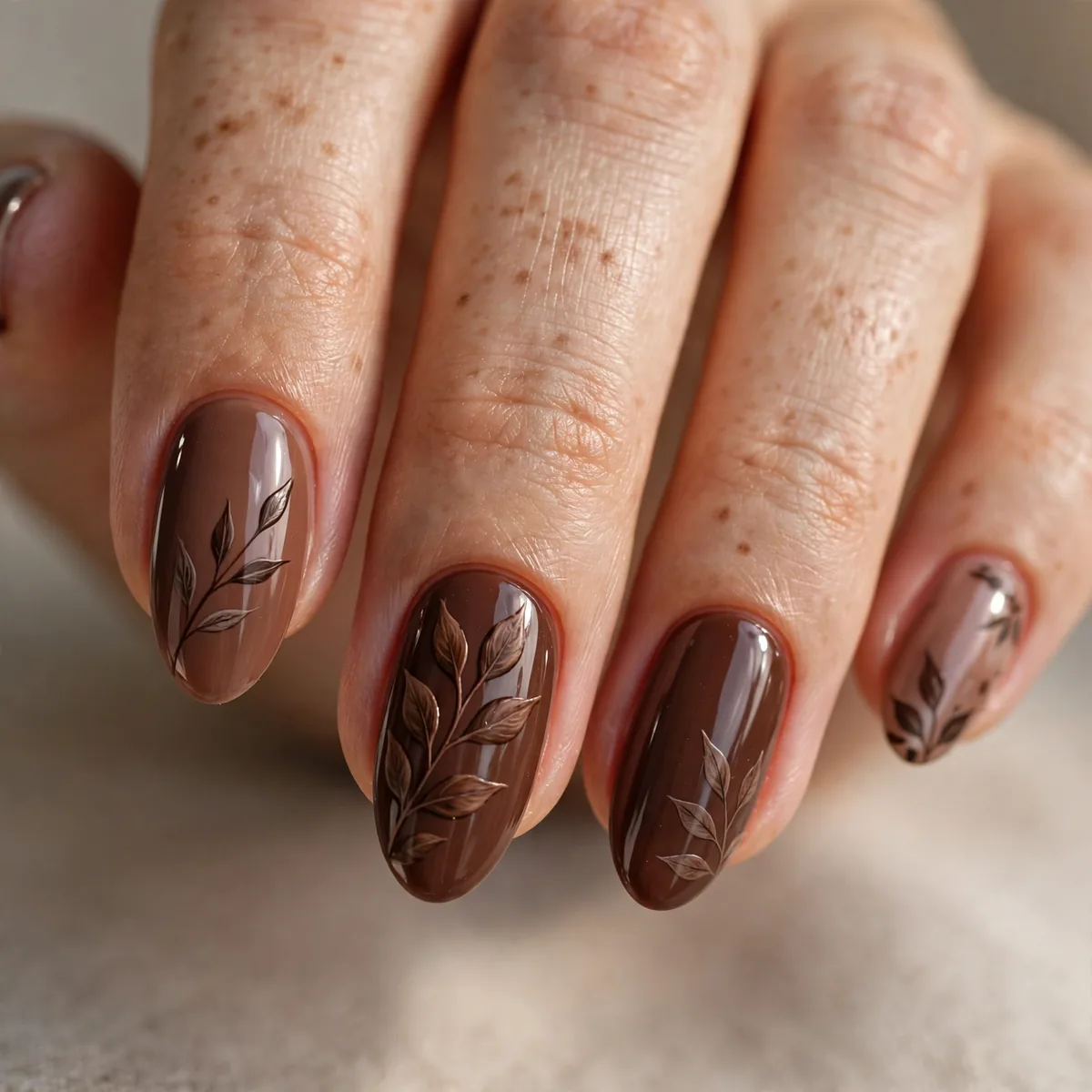
Leaves on deep chocolate — the rich fall.
Best for: the cozy. Chocolate + leaves = hot cocoa vibes.
Chocolate brown is fall’s coziest neutral — choose a crème with red undertones for warmth rather than a gray-brown, which reads muddy. Paint leaves in gold, copper, or burnt orange metallics so they glow against the dark base. Two coats reach full opacity; chocolate shades are usually well-pigmented. This base hides tip wear brilliantly, stretching the manicure past the ten-day mark with ease.
Chocolate and leaves together smell like a bakery in the best way — this design pairs with oversized sweaters, cinnamon candles, and weekend farmers markets. Keep cuticles deeply moisturized; dark polish against dry skin looks harsh. If the brown feels too heavy alone, add one nude accent nail with a single leaf to lighten the set. A glossy top coat makes the chocolate look edible, which is exactly the point.
Watercolor Leaves
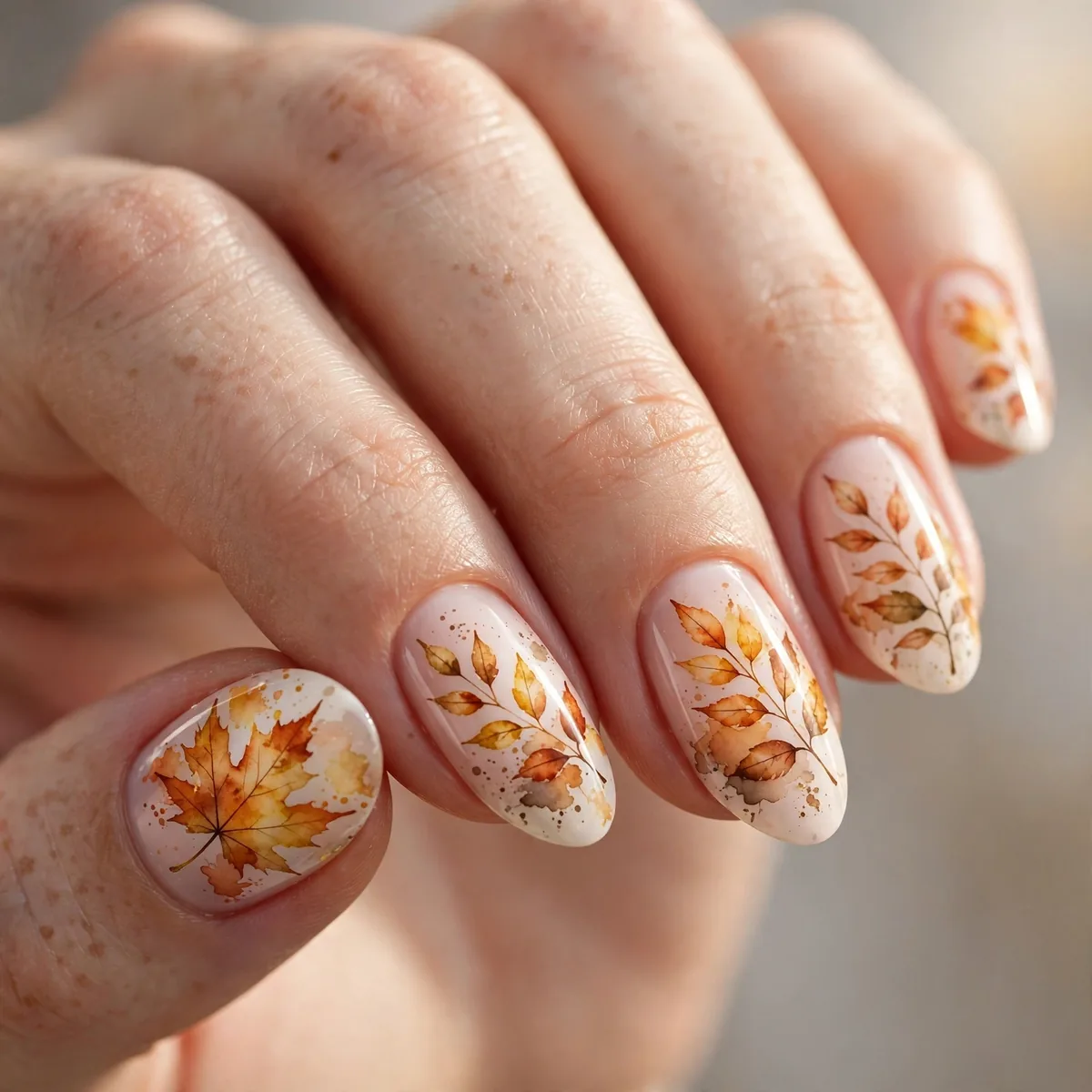
Soft watercolor leaves — the artistic fall.
Best for: the painterly. Watercolor leaves look hand-painted because they are.
True watercolor leaves come from translucent color — dilute polish with clear base or work with alcohol inks for that stained-glass softness. Layer washes of amber, rust, and gold, letting each dry before the next so colors stay distinct. Feather the leaf edges outward with a dry brush for the painted-bleed effect. A white or milky base underneath makes every wash glow brighter.
Watercolor is the most forgiving nail art technique — softness is the goal, so there are no mistakes, only happy accidents. This makes it the perfect entry point for anyone intimidated by detailed leaf painting. Seal with two top coat layers since thin washes wear faster than opaque polish. Try the same technique in spring pastels when fall ends; the method travels beautifully across seasons.
Glitter Leaf Accent
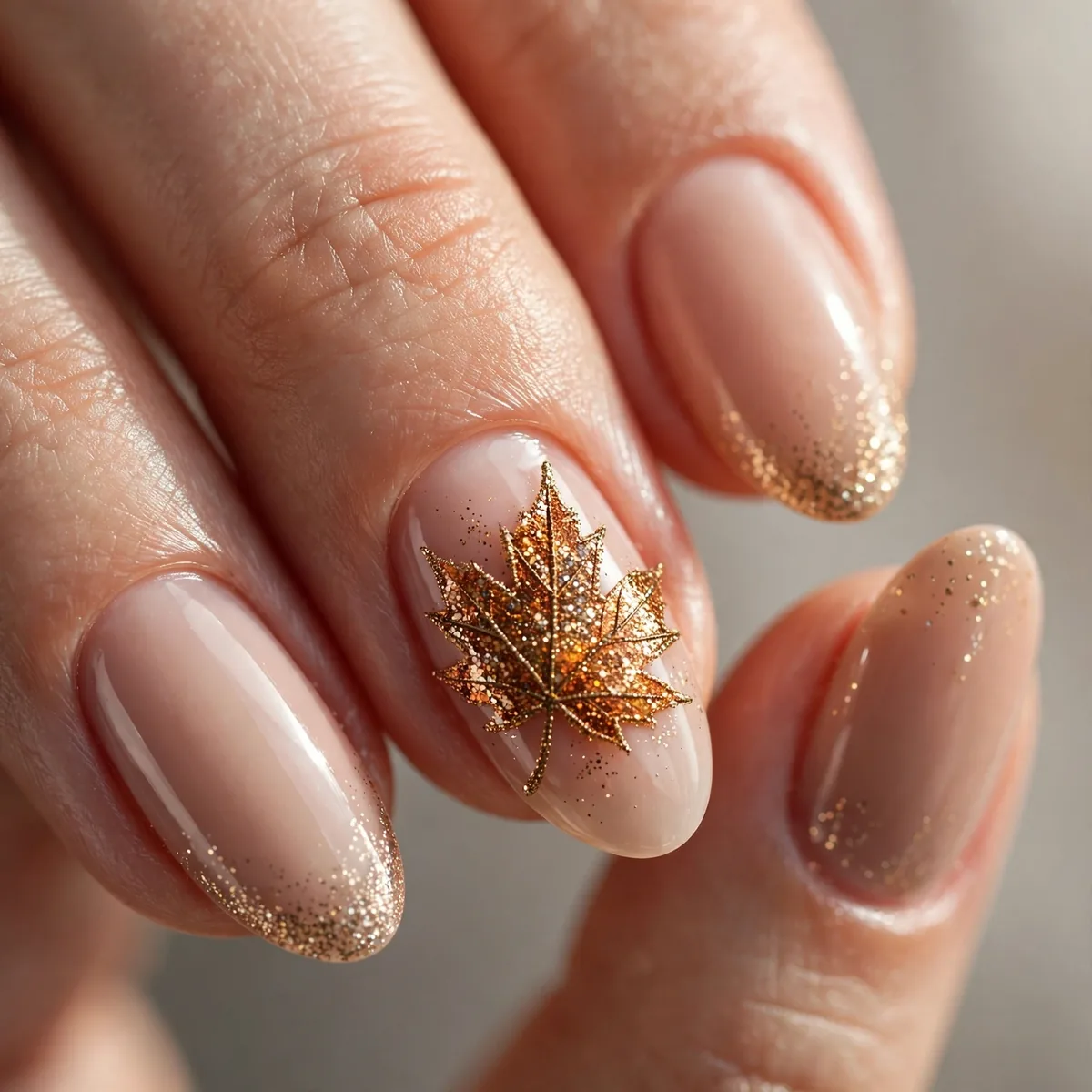
One glitter leaf among matte — the sparkling fall.
Best for: the festive. Glitter leaves catch autumn light.
One glitter leaf against matte solids creates the sharpest contrast — the sparkle reads as intentional rather than scattered. Paint the leaf in a fine gold or copper glitter over a matching crème base so gaps do not show bare nail. Press glitter while the base is tacky, then encapsulate with two top coat layers to smooth the texture. Place the glitter leaf on the ring finger for classic accent balance.
This is the holiday-party version of fall nails — the glitter catches low autumn light and candlelight beautifully. Keep the surrounding nails in a flat matte finish; the contrast is what makes the single glitter leaf feel special. Fine-milled glitter wears smoother than chunky flakes and snags less on knit sweaters. Reapply top coat midweek, since glitter edges lift first and dull the shine.
Negative Space Leaves
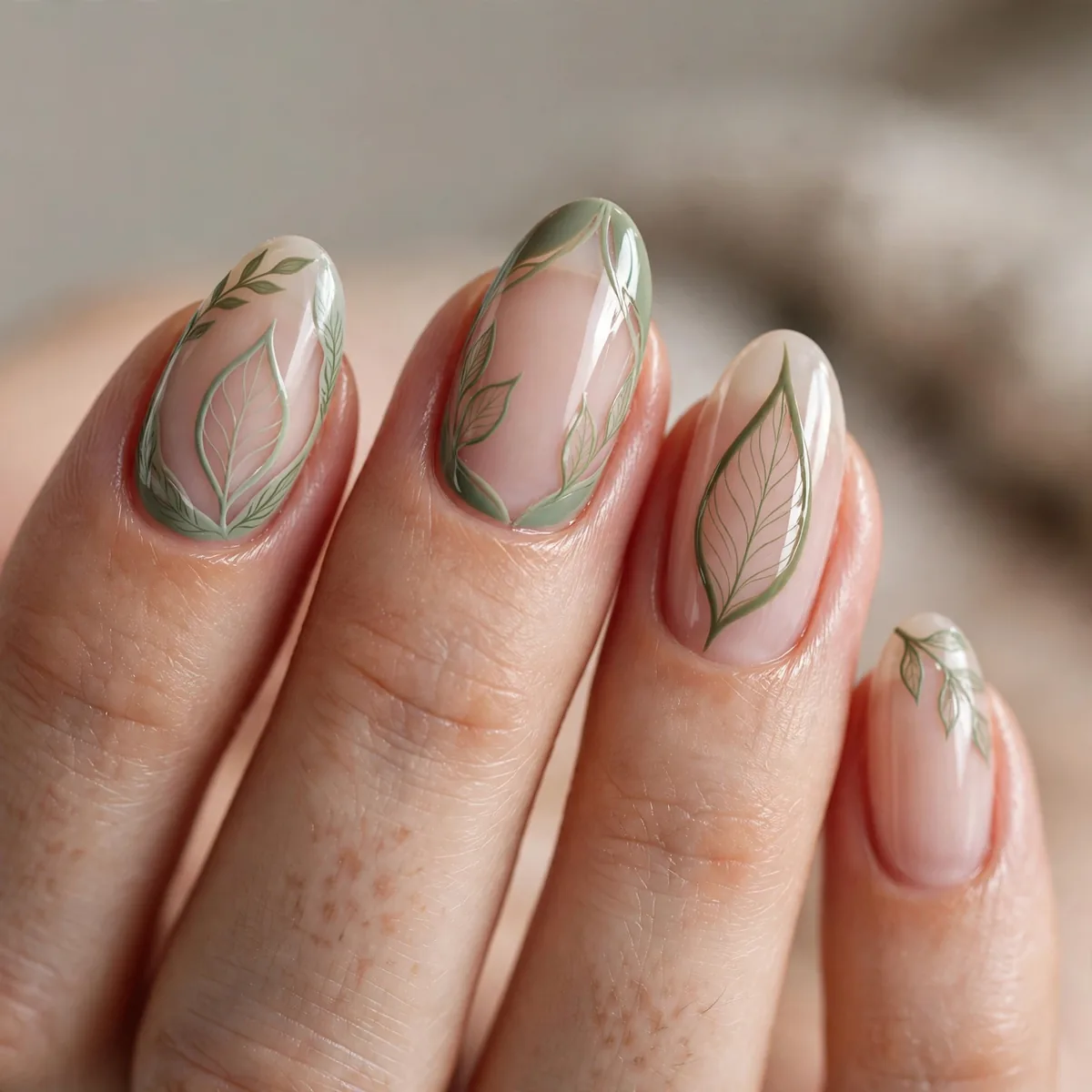
Leaves in negative space — the modern fall.
Best for: the contemporary. Negative space keeps leaves current.
Negative space leaf designs start with immaculate prep — the bare nail is the background, so buff smooth and push cuticles back cleanly. Use leaf stencils or vinyl cutouts for crisp edges; paint fall shades around them, then peel while the polish is just dry to the touch. Thin coats prevent flooding under the stencil edges. Almond or oval shapes give the composition its most graceful frame.
Bare-nail designs grow out invisibly, making this the lowest-maintenance leaf art in the roundup — two weeks of wear with no obvious regrowth line. The look reads modern and editorial, perfect for anyone who finds traditional fall nails too literal. The one risk is lifting at the stencil edges, so cap every edge with top coat. Keep nails oiled daily; the natural nail is half the design.
Oak Leaf Detail
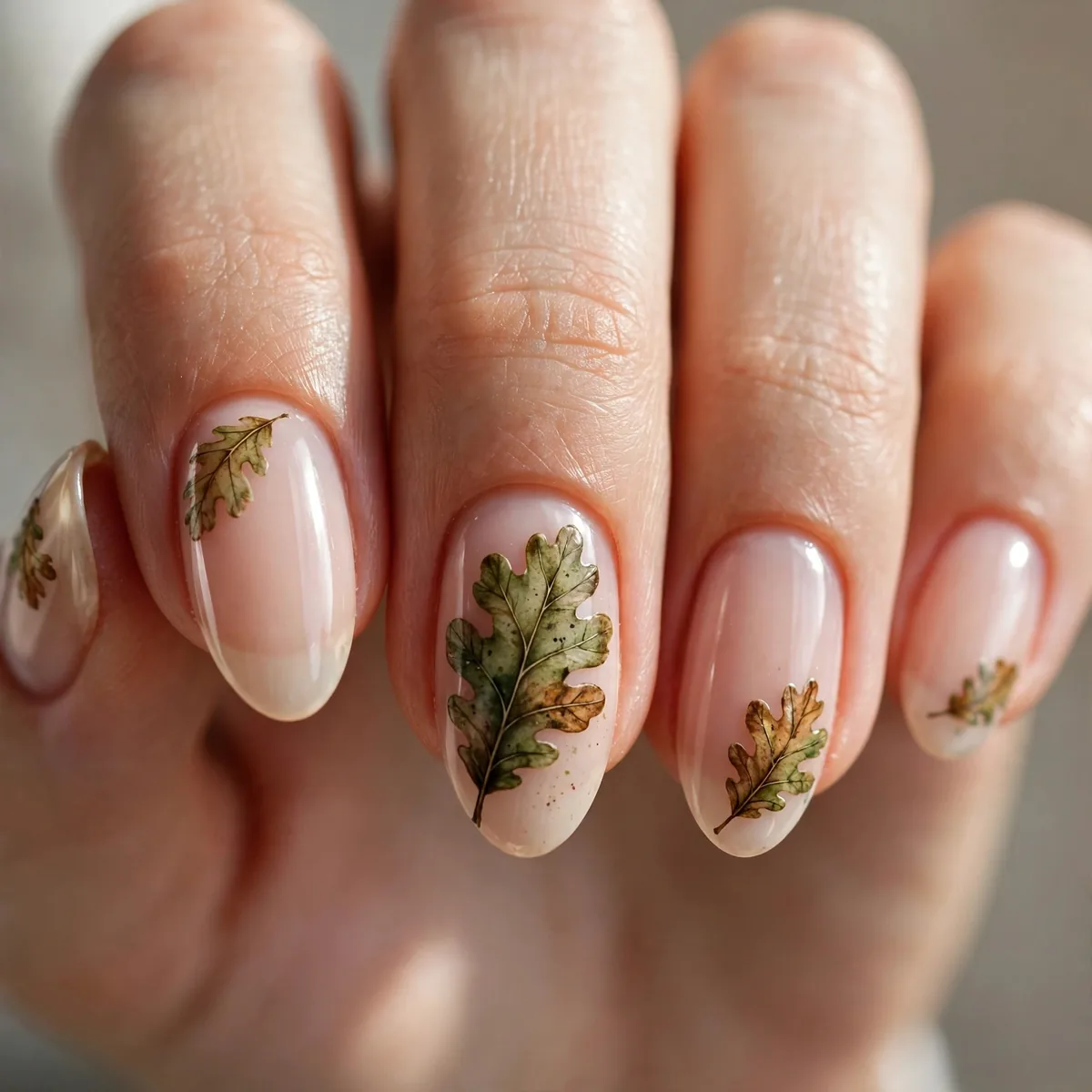
Detailed oak leaves — the botanical fall.
Best for: the precise. Oak leaves reward a steady hand.
Oak leaves have distinctive rounded lobes — study a reference photo first, because generic leaf shapes will not read as oak. Paint the lobes with a small round brush in smooth arcs, then add the central vein and side veins with a liner brush in a darker shade. Work on one nail at a time so the paint stays workable. Deep green or russet oak leaves over a cream base look most botanical.
Oak leaves reward patience — this is slow, detailed work, so set aside a quiet hour and good lighting. The botanical accuracy is what makes the design special; fellow nature lovers will recognize the species instantly. If hand-painting lobes defeats you, oak leaf stamping plates exist and look remarkably precise. Seal with a glossy top coat to give the illustration a pressed-herbarium shine.
Leaf French Tips
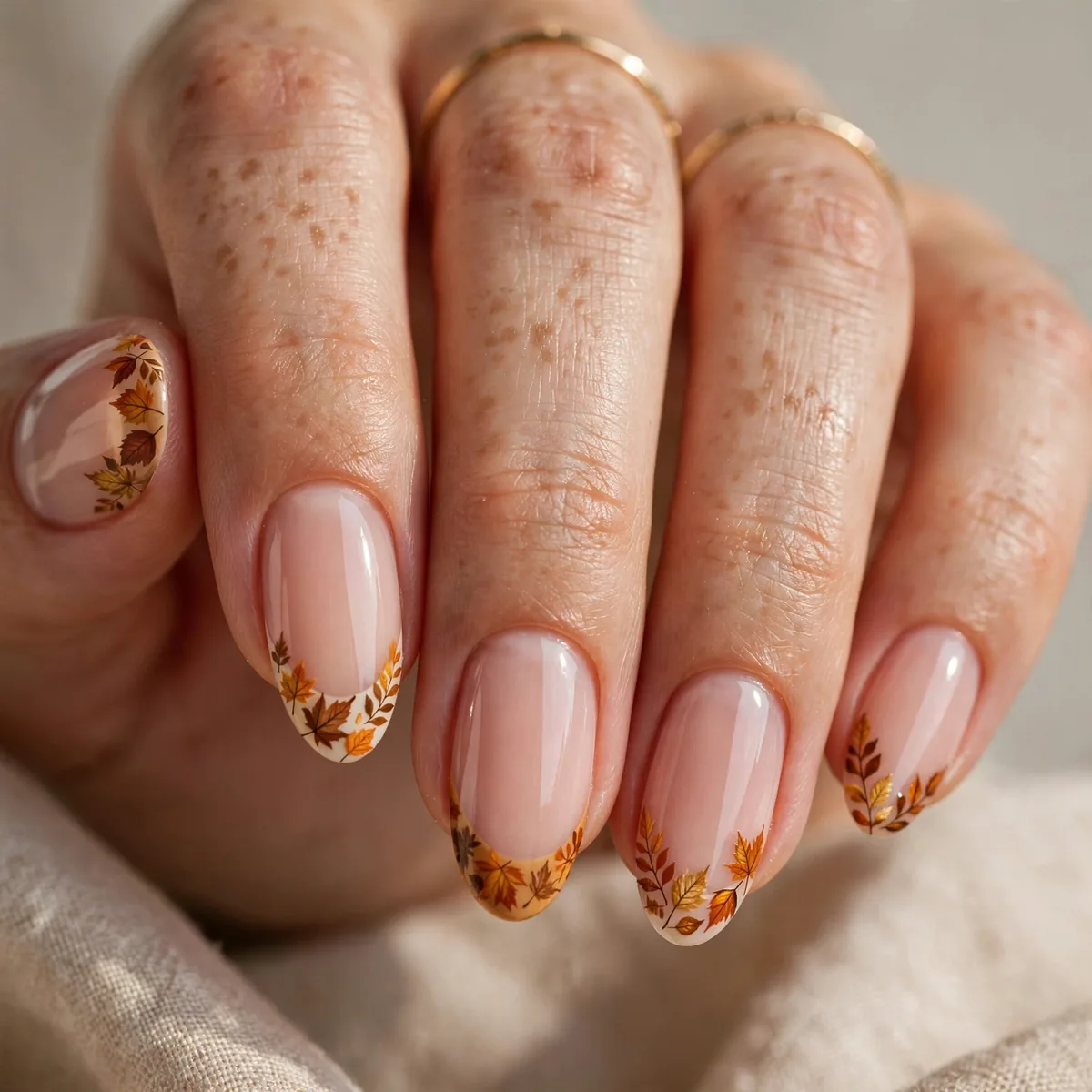
French tips with tiny leaves — the fall French.
Best for: French lovers. Leaves update the classic seasonally.
A fall French starts with the classic smile line — paint it in burnt orange, gold, or deep red instead of white for instant seasonal character. Add a tiny leaf at one corner of the tip, no larger than a few millimeters, so it accents rather than crowds. Use a striping brush for the smile line and a dotting tool for the leaf. Short to medium nails carry this best; very long tips distort the proportion.
The French manicure is timeless, and seasonal tips keep it feeling current without abandoning the classic. This design works beautifully for fall weddings and office settings where full nail art might feel like too much. The tiny leaf is the detail people notice on the second look — the best kind of surprise. Refresh the top coat every few days, since French tips show wear at the smile line first.
Harvest Moon Leaves
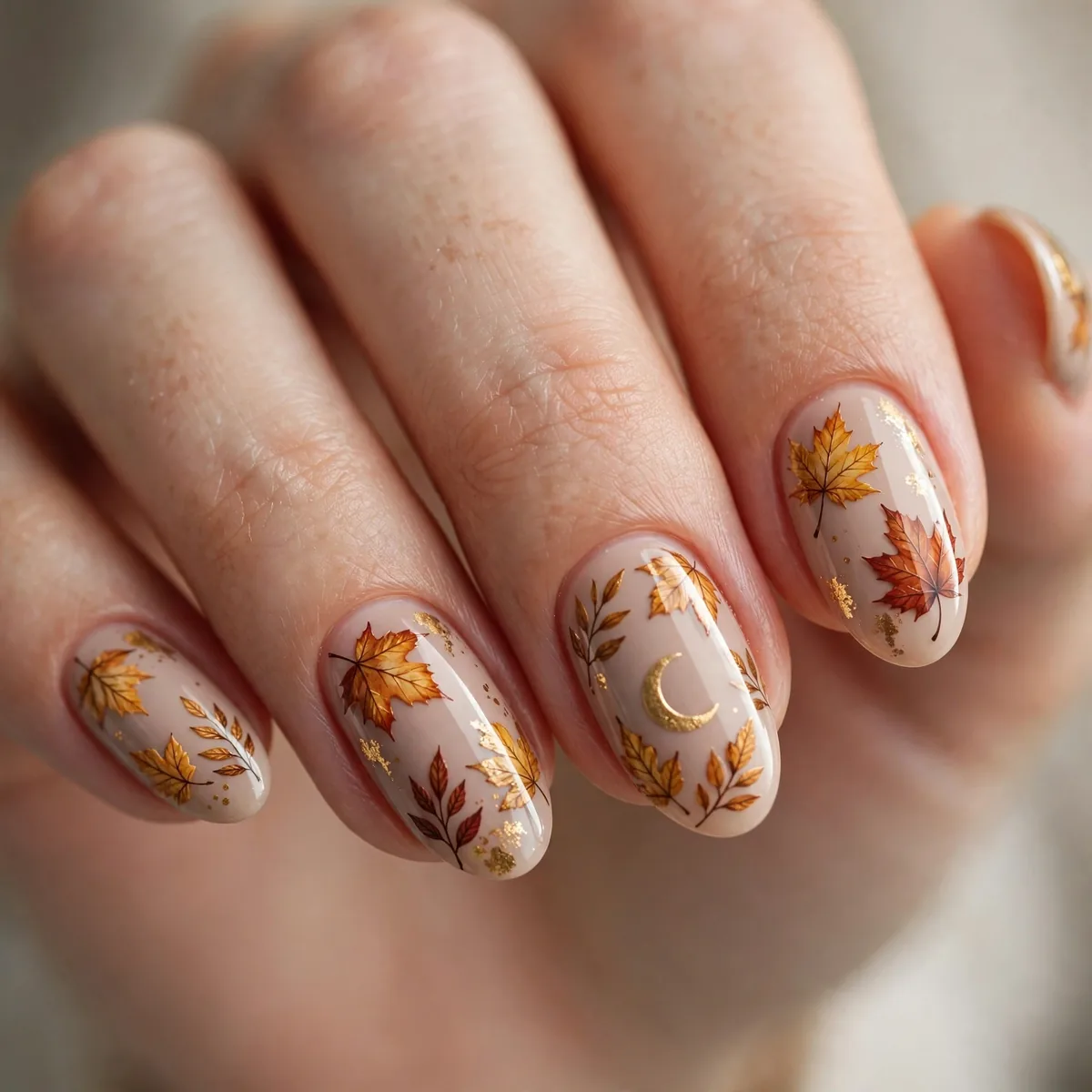
Leaves against a harvest moon — the autumn night.
Best for: the atmospheric. Moon + leaves = fall magic.
Build the night sky first — a deep navy or plum base sponged with black at the edges creates real depth. Paint the harvest moon as a large warm gold circle, slightly off-center, then scatter small leaves in rust and amber around it. Add tiny white dots as stars with a dotting tool. Let the dark base dry fully before the moon goes on, or colors will muddy.
This is the most atmospheric design in the roundup — it tells a whole autumn evening on ten nails. Longer nails give the moon and leaves room to breathe; short nails crowd the composition. Dark bases hide wear beautifully, so this set lasts a solid ten days. Photograph it against actual evening skies for the full effect; the gold moon practically glows in the shot.
Pressed Leaf Realism
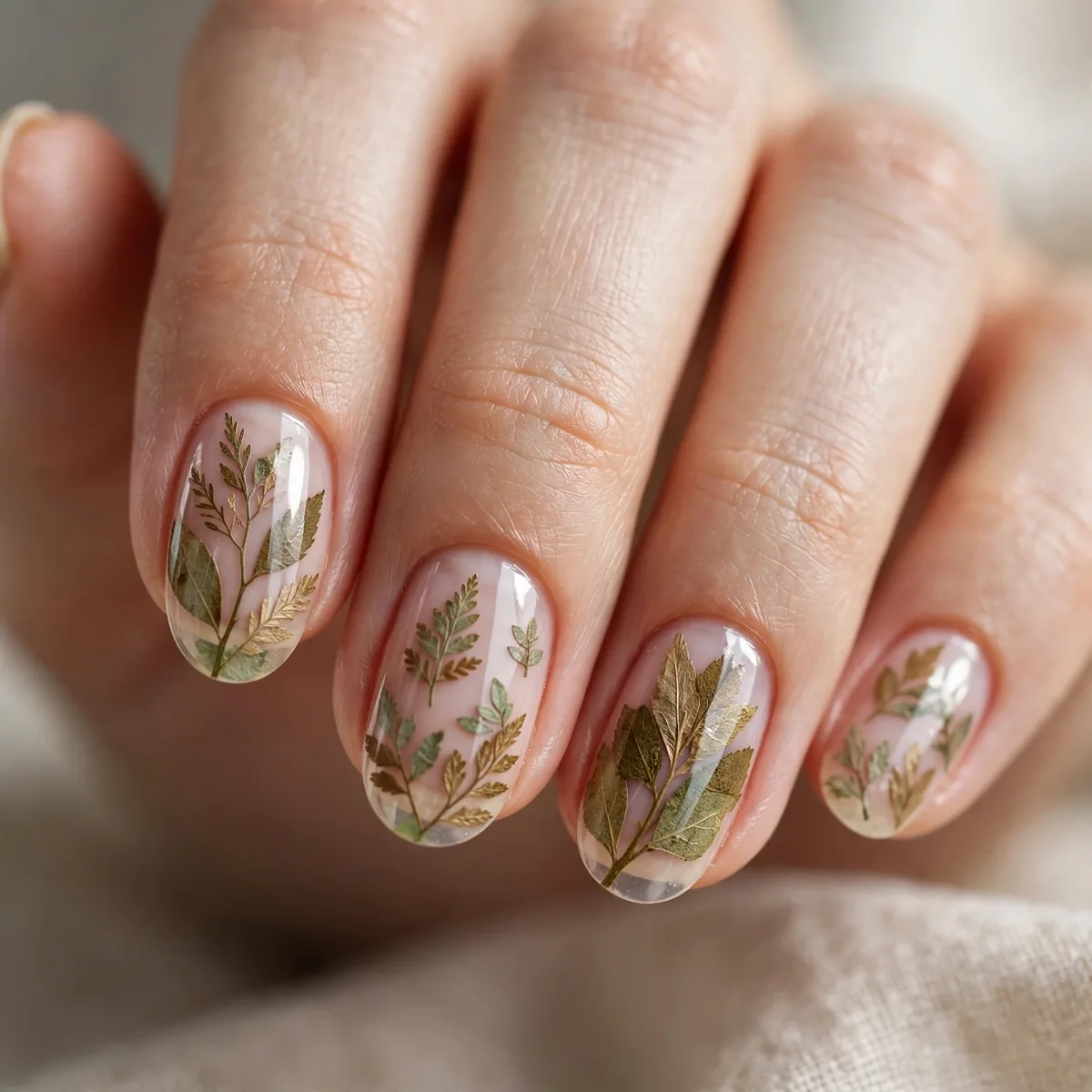
Hyper-realistic leaves — the botanical illustration.
Best for: the skilled. Realism is fall’s highest art.
Realism comes from layering — start with the leaf silhouette, then add vein details, edge shading, and tiny color variations in progressively darker tones. A fine liner brush and a steady hand are non-negotiable; rest your wrist on the table for control. Work from light to dark so mistakes stay correctable. Honestly, quality nail stickers achieve this look in seconds — there is no shame in the shortcut.
Hyper-realistic leaves look like tiny botanical illustrations — the effect is genuinely stunning when done well. This is advanced work, so do not attempt it the night before an event; practice on a nail wheel first. The detail rewards close viewing, making it perfect for anyone whose hands get noticed. Seal with a thick glossy top coat to give the leaves a lacquered, preserved-under-glass finish.
Copper Leaf Shine
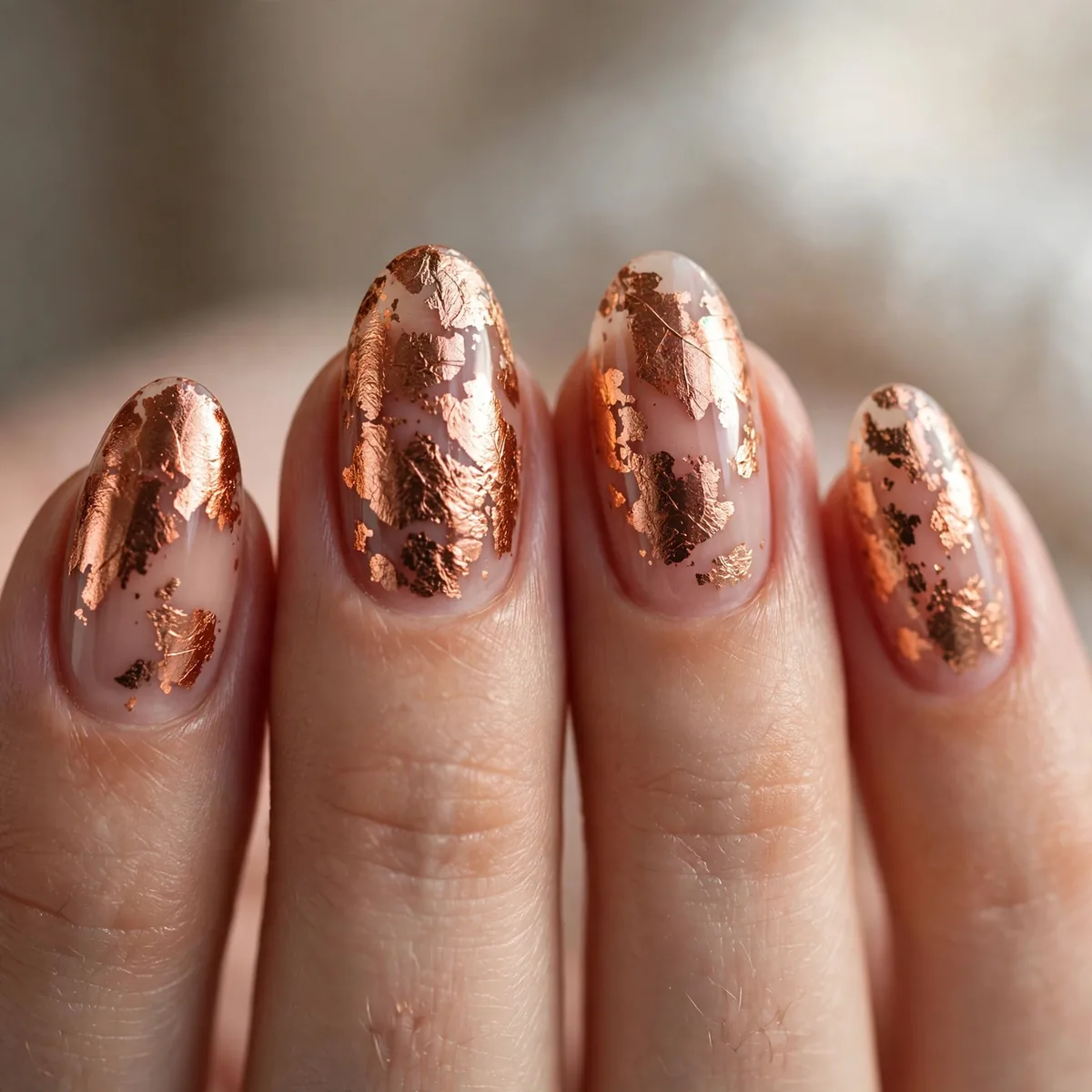
Metallic copper leaves — the gleaming fall.
Best for: the luminous. Copper leaves glow like autumn sun.
Copper metallic polish looks best over a warm base — a thin layer of burnt orange underneath deepens the metal and hides any sheer spots. Apply metallics in smooth, single-direction strokes; back-and-forth brushing creates visible streaks. Two coats usually reach full shine. Leaf shapes painted in copper over a chocolate or plum base glow like embers — the quintessential autumn metallic.
Copper is autumn sunlight in polish form — it flatters every skin tone and pairs with the season’s entire palette. Metallics show every ridge, so a ridge-filling base coat matters more here than anywhere. The finish wears about a week before the shine dulls at the tips; a fresh top coat revives it instantly. Try copper leaves over forest green next — the complementary contrast is striking.
Yellow Ginkgo Fans
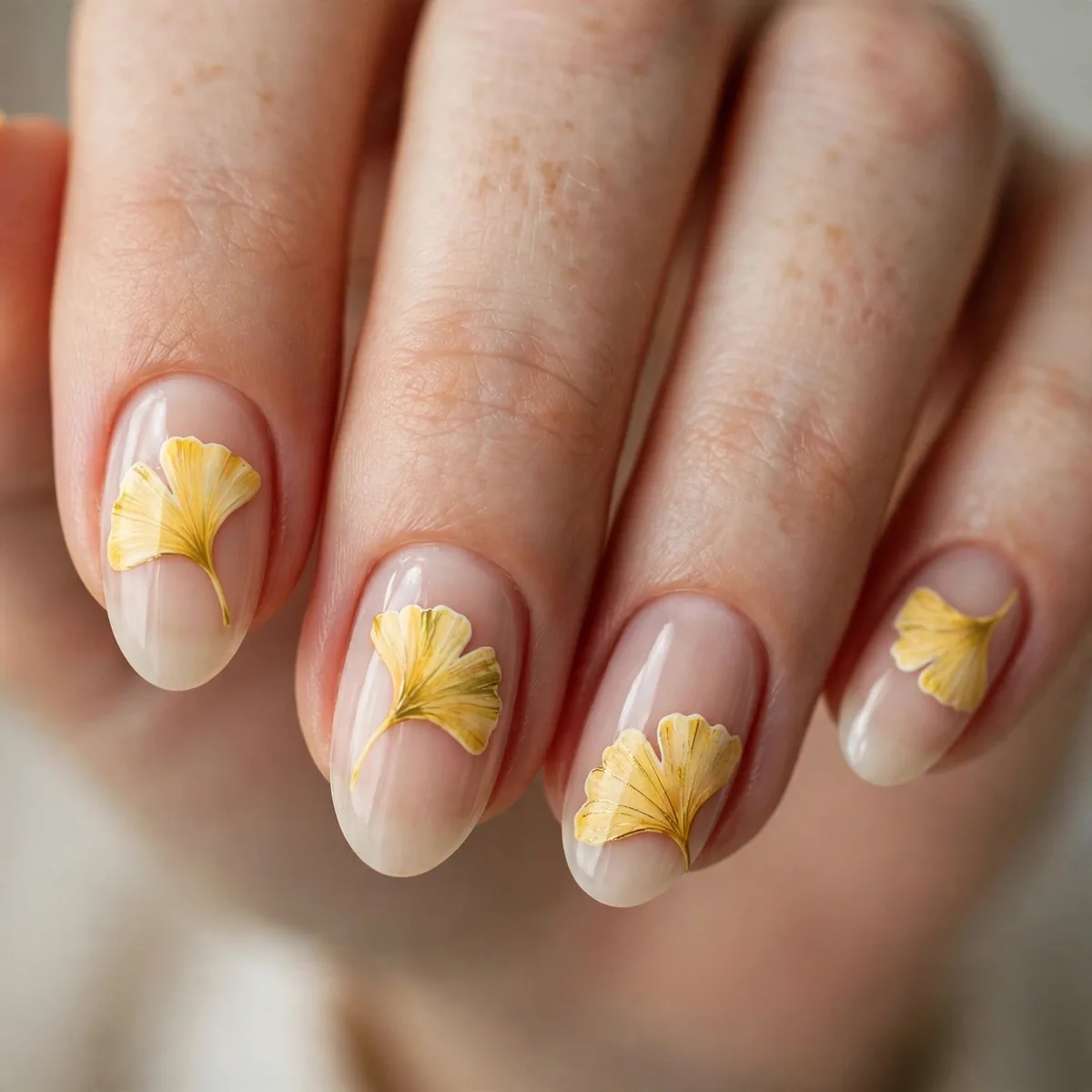
Fan-shaped ginkgo in yellow — the unique fall.
Best for: the distinctive. Ginkgo is autumn’s most elegant leaf.
Ginkgo leaves are unmistakable — fan-shaped with a split center, and surprisingly easy to paint with a flat brush pressed and fanned outward. Golden yellow is the classic ginkgo shade, though chartreuse reads more modern. Keep the fan small and place it toward the tip so the shape stays legible. A deep green or navy base makes yellow ginkgo pop like stained glass.
Ginkgo is the connoisseur’s autumn leaf — fellow design lovers will appreciate the botanical specificity. The fan shape suits short nails beautifully, where it reads as a delicate emblem rather than a full illustration. This design transitions into early winter nicely; gold ginkgo on deep green feels almost festive. Add a matte top coat for a modern, paper-like finish that suits the botanical theme.
Bare Branch Contrast
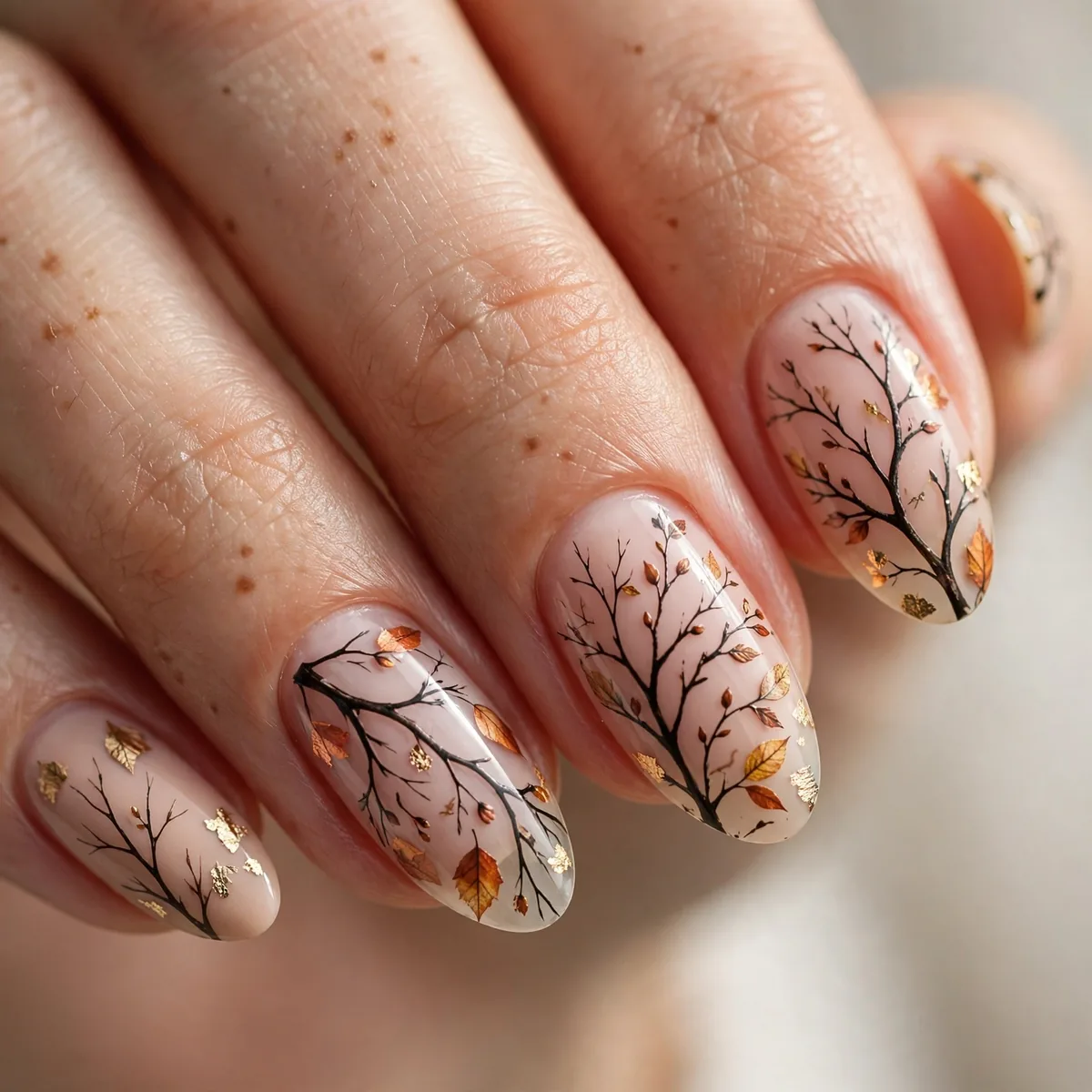
Bare branches with single leaves — the poignant fall.
Best for: the poetic. Branches tell autumn’s deeper story.
Bare branches are painted with the lightest touch — a liner brush dragged in thin, tapering strokes, branching into smaller twigs at the ends. Black or deep brown branches over a soft gray or blush base create the starkest, most poetic contrast. Add a single small leaf in burnt orange for the poignant finishing touch. Keep branches asymmetric; perfect symmetry kills the natural feel.
This is the most emotional design in the roundup — it tells autumn’s deeper story of letting go. The minimalism makes it deeply wearable, even in conservative settings where leaf art might feel loud. Longer almond nails give branches the vertical space they need to stretch elegantly. Seal carefully around the thin branch lines, which are the first detail to wear — a second top coat layer on art nails helps.
The Foliage Capsule
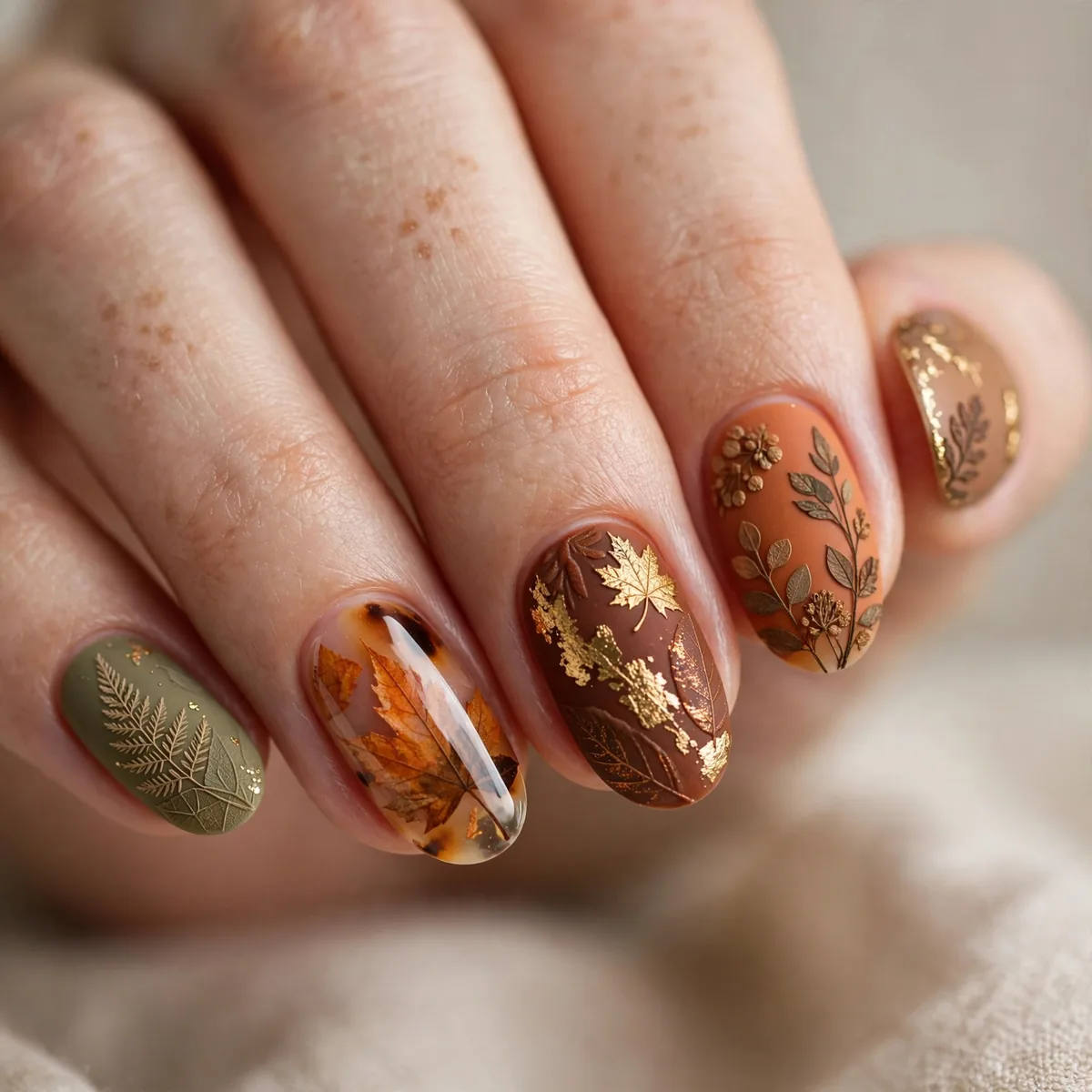
Orange, gold, brown, red — the four-bottle fall.
Best for: the season. Four hues, endless foliage.
A four-polish capsule covers the whole season — burnt orange, antique gold, chocolate brown, and oxblood red mix into endless foliage combinations. Invest in quality formulas for these workhorses; you will wear them from September through November. Store bottles upright away from heat so the metallics do not separate. Swatch each shade on a nail wheel first to learn which pairings sing together.
Rotate the four shades weekly and a small collection feels like an endless autumn wardrobe — solids one week, leaf art the next. These core colors also work beyond foliage: gold for holiday parties, chocolate for everyday, oxblood for date nights. Photograph your favorite combinations in a phone album for easy reference. Gift the set to a friend building her fall polish wardrobe; it is the perfect seasonal starter kit.
Fall in love with foliage. Save your leaf looks — and for more autumn moods, see our fall nail ideas and pumpkin spice nails.